 EN
Why Sugarcane Bagasse Cutlery Leads the Biobased Tableware Transition
Superior heat resistance and cost efficiency vs. PLA and PHA alternatives
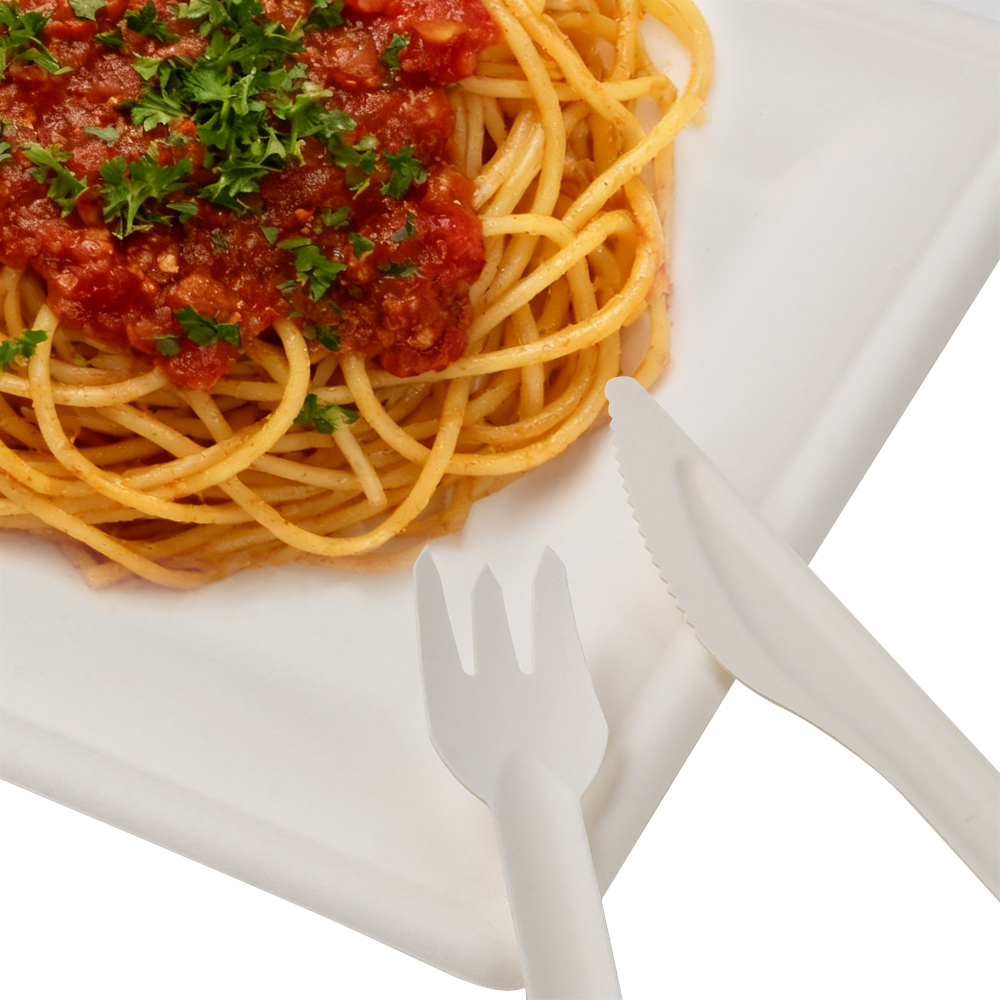
Sugarcane bagasse cutlery leads the biobased tableware transition by delivering exceptional heat resistance at lower production costs than leading biopolymers. Polylactic acid (PLA) cutlery begins to soften near 60°C—making it unsuitable for hot soups, sauces, or microwave reheating—while many polyhydroxyalkanoate (PHA) grades warp above 80–90°C. In contrast, certified bagasse cutlery withstands microwave heating up to 120°C and oven baking up to 220°C, enabling foodservice operators to use a single disposable line for both hot and cold applications. Its inherent oil and water resistance further eliminates the need for plastic coatings.
Cost advantages stem from feedstock origin: bagasse is a high-volume, zero-cost byproduct of sugar milling, whereas PLA and PHA require energy-intensive fermentation, extraction, and polymerization. Industry benchmarks indicate bagasse cutlery can be 20–35% less expensive per unit than comparable PLA items at scale—a performance-cost balance that makes it the pragmatic default for sustainable procurement.
Lifecycle advantage: Lower carbon footprint than plastic, wood, and molded fiber competitors
Sugarcane bagasse cutlery starts its lifecycle as waste—not a dedicated crop—so it demands no additional land, irrigation, or fertilizer. A 2022 cradle-to-gate assessment found its carbon footprint at approximately 0.8 kg CO₂e per kg, compared with 3.1 kg CO₂e per kg for conventional polypropylene cutlery. Wood-based alternatives carry higher burdens due to energy-intensive harvesting, kiln drying, and shaping—especially when sourced from monoculture forestry. Molded fiber products made from virgin wood pulp add emissions and water use through pulping and bleaching.
Because bagasse would otherwise be burned (releasing particulates and black carbon) or landfilled (generating methane), its conversion into tableware avoids those emissions while creating value from waste. At end of life, certified compostable bagasse items fully degrade into nutrient-rich soil amendments—returning carbon to the biosphere rather than persisting as microplastics. This combination of avoided emissions, waste valorization, and circular end-of-life gives bagasse a lower overall lifecycle impact than most fossil-based and biobased alternatives.
Decoding Global Compostability Certifications for Sugarcane Bagasse Cutlery
Claims of compostability in the EU, U.S., and Australian markets require rigorous third-party verification of the entire product formulation—including fiber, coatings, additives, and adhesives—not just the base material.
ASTM D6400, EN 13432, and TÜV OK Compost Home: Key requirements for disintegration, ecotoxicity, and heavy metals
ASTM D6400 (2021) defines the U.S. industrial composting standard: certified items must achieve 90% disintegration through a 2 mm sieve within 84 days and convert 90% of their organic carbon to CO₂ within 180 days—while leaving no toxic residue. EN 13432 (2000), the EU’s benchmark, adds stricter limits on ecotoxicity and 11 heavy metals—including lead, cadmium, mercury, and chromium—and requires finished compost to support healthy plant germination. TÜV OK Compost Home raises the bar further by validating performance under ambient conditions (20–30°C) over up to 12 months, reflecting real-world home composting—not lab-controlled reactors.
Together, these certifications confirm that properly formulated sugarcane bagasse cutlery degrades without generating persistent microplastics or leaching harmful additives—transforming environmental claims from marketing language into verifiable, science-backed outcomes.
The 'home compostable' gap: Why TÜV OK Compost Home and AS 5810 demand real-world validation beyond lab conditions
Home compostable certification is significantly more demanding than industrial compostability because backyard systems lack the controlled heat, moisture, and aeration of laboratory reactors. While ASTM D6400 and EN 13432 rely on stable 58°C environments with continuous aeration, TÜV OK Compost Home and AS 5810 (2010) require degradation under variable ambient temperatures, periodic turning, and pass/fail toxicity tests using earthworms and seedling germination assays—over up to 12 months.
As a result, bagasse cutlery may meet industrial standards yet fail home compost validation if wall thickness, coating chemistry, or additive load slows microbial breakdown. Buyers targeting EU and Australian markets should request pilot test reports from actual home compost trials—not just lab certificates—to ensure “compostable” claims hold up where it matters most: in consumers’ backyards.
Beyond Certification: Supply Chain Transparency and End-of-Life Realities for Sugarcane Bagasse Cutlery
Case evidence: EU rollout shows 62% landfill diversion failure due to sorting infrastructure gaps—not material flaws
Field data from a large-scale EU rollout revealed a 62% landfill diversion failure rate for certified sugarcane bagasse cutlery—not because the material failed to compost, but because existing waste infrastructure couldn’t reliably identify or separate it from conventional plastics. Sorting facilities lacked optical recognition markers, and mixed-waste streams were routinely routed to landfill or incineration regardless of certification status.
This outcome underscores a critical reality: compostability certification confirms what a product can do, not what will happen to it. Without alignment between product design, labeling, collection protocols, and local processing capacity, even perfectly certified items miss their circular intent. Procurement teams must therefore verify whether target markets have active industrial composting programs—and whether those programs accept and process certified bagasse—before making environmental claims. Supply chain transparency isn’t optional; it’s the essential bridge between certification and impact.
Regulatory Catalysts: How Plastic Bans Accelerate Adoption—and Expose Certification Limitations
Single-use plastic bans are the strongest regulatory catalyst driving adoption of certified compostable sugarcane bagasse cutlery. The EU’s Single-Use Plastics Directive and European Green Deal have accelerated foodservice shifts toward biobased alternatives, with European Commission projections estimating a 25–30% increase in biodegradable material use by 2025. Similar restrictions across North America and parts of Asia are pushing procurement toward materials bearing recognized credentials such as EN 13432, BPI Compostable, and TÜV OK Compost Home.
Yet this same momentum exposes the limitations of certification alone. A label does not guarantee that local collection systems recognize the item, that sorting facilities can isolate it, or that industrial composters accept it—especially when regional standards differ or documentation fails customs scrutiny. As a result, procurement teams must now validate that supplier certifications match destination-market requirements in practice, not just on paper—avoiding rejected shipments, clearance delays, and reputational risk from unfulfilled sustainability promises.
FAQ Section
What makes sugarcane bagasse cutlery superior to PLA and PHA alternatives?
Sugarcane bagasse cutlery offers better heat resistance (up to 120°C for microwaving and 220°C for oven baking) and is more cost-efficient due to its feedstock origin as a zero-cost byproduct of sugar milling.
How is sugarcane bagasse cutlery more eco-friendly than plastic or wood-based alternatives?
Bagasse cutlery starts as waste, avoiding land, irrigation, or fertilizer use. Its lifecycle has a lower carbon footprint compared to plastic (0.8 kg CO₂e per kg versus 3.1 kg CO₂e per kg for polypropylene). It also fully biodegrades into nutrient-rich soil without producing microplastics.
What certifications should I look for in compostable bagasse cutlery?
Key certifications include ASTM D6400 (U.S.), EN 13432 (EU), and TÜV OK Compost Home, which validate disintegration, safety, and composting performance under industrial and home composting conditions.
Why is home compostability harder to achieve than industrial compostability?
Home composting lacks the controlled heat and aeration of industrial systems. Certifications like TÜV OK Compost Home and AS 5810 demand validation under real-world conditions, including variable ambient temperatures and microbial breakdown over 12 months.
How can procurement teams ensure bagasse cutlery will be composted?
Teams must verify if local composting programs accept certified bagasse items and align product design, labeling, and collection infrastructure to support proper disposal and processing.
Table of Contents
- Why Sugarcane Bagasse Cutlery Leads the Biobased Tableware Transition
- Decoding Global Compostability Certifications for Sugarcane Bagasse Cutlery
- Beyond Certification: Supply Chain Transparency and End-of-Life Realities for Sugarcane Bagasse Cutlery
- Regulatory Catalysts: How Plastic Bans Accelerate Adoption—and Expose Certification Limitations
-
FAQ Section
- What makes sugarcane bagasse cutlery superior to PLA and PHA alternatives?
- How is sugarcane bagasse cutlery more eco-friendly than plastic or wood-based alternatives?
- What certifications should I look for in compostable bagasse cutlery?
- Why is home compostability harder to achieve than industrial compostability?
- How can procurement teams ensure bagasse cutlery will be composted?


