 EN


Capacity Range and Structural Design of Sugarcane Bagasse Bowls
Why 8oz to 24oz Covers Core Food Service Needs
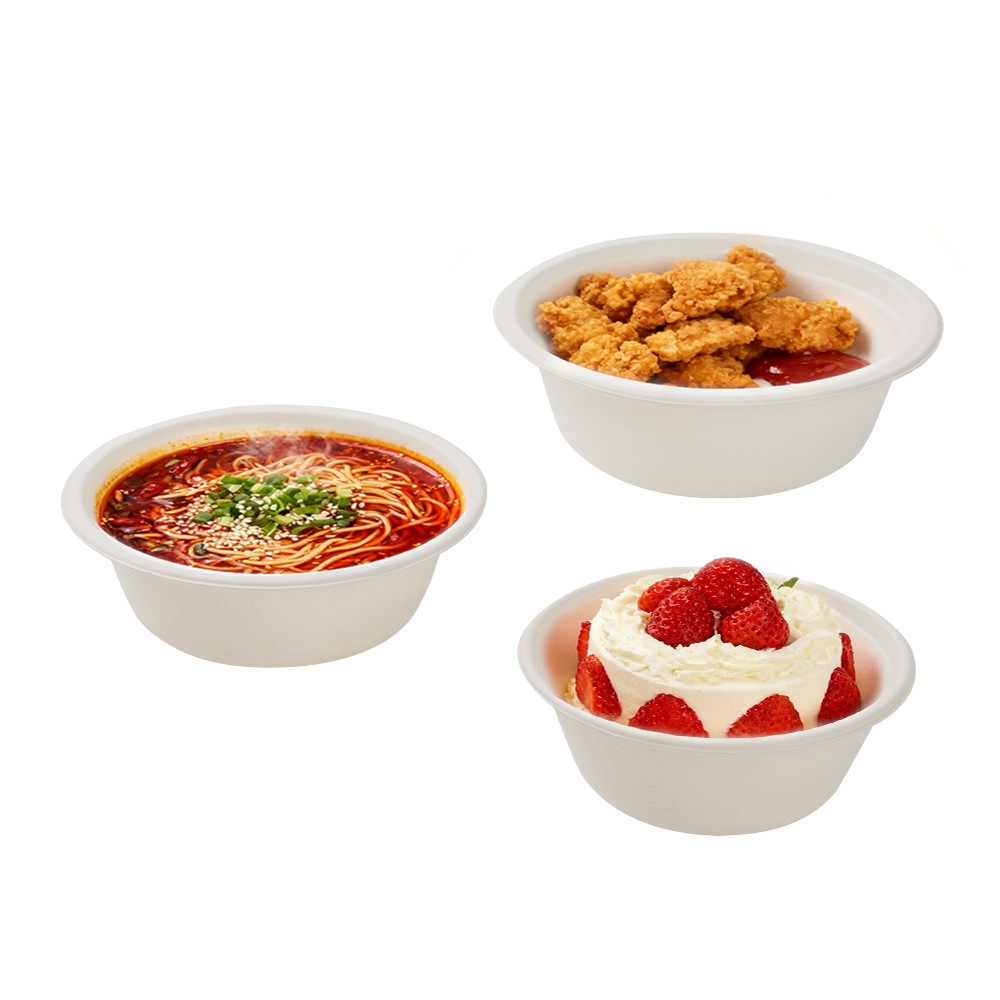
Sugarcane bagasse bowls in the 8oz to 24oz range align with standard portion sizes across food service operations. Smaller 8–10oz bowls suit condiments, sides, and desserts; 12–16oz sizes accommodate soups, grain bowls, and pasta; and 20–24oz capacities handle large salads, noodle bowls, and main-course portions. Their deep walls and stable base minimize sloshing, while the fiber-based construction resists leaks without plastic liners. This single-format coverage streamlines inventory, reduces packaging complexity, and supports full menu flexibility—from appetizers to entrees—with one compostable solution.
How Wall Thickness, Pulp Density, and Rim Geometry Scale with Capacity
As capacity increases, structural demands rise—requiring proportional adjustments in wall thickness, pulp density (measured in grams per square meter, GSM), and rim geometry to maintain rigidity and leak resistance:
| Capacity | Wall Thickness | Pulp Density (GSM) | Rim Geometry |
|---|---|---|---|
| 8oz | ~0.8 mm | 280–320 g/m² | Light rolled or straight edge |
| 16oz | ~1.0 mm | 350–420 g/m² | Medium-rolled, slightly widened |
| 24oz | ~1.2 mm | 450–550 g/m² | Reinforced rolled edge or wide flange |
Larger bowls often feature double-rolled rims or extended flanges that distribute mechanical stress and resist bending during stacking and handling. Independent testing confirms well-engineered bagasse bowls support up to 2.5 lbs without warping—ensuring consistent performance across capacities in real-world service conditions.
Matching Sugarcane Bagasse Bowl Capacity to Food Type and Thermal Profile
Oil-Rich, Hot, or Acidic Foods: Why Depth-to-Surface Ratio Matters Most
Performance with oil-rich, hot, or acidic foods hinges less on raw capacity and more on depth-to-surface ratio—the geometric relationship between bowl depth and opening diameter. Deeper, narrower bowls reduce exposed surface area, limiting air contact and slowing heat loss, oxidation of fats, and acid-driven fiber degradation. Bagasse naturally resists oil penetration for over 45 minutes, and a smaller surface area further delays wicking and staining. With a verified heat tolerance up to 212 °F (100 °C), deeper designs retain warmth significantly longer than shallow alternatives—critical for soups, curries, or buffet service where thermal stability affects both safety and experience. Selecting capacity based on this ratio—not just volume—ensures reliable containment for demanding menu items.
Real-World Validation: Leakage Reduction in Meal Kits via Capacity-Specific Sizing
A 2023 industry survey found leading meal-kit providers reduced container failures by 78% after switching to capacity-specific sugarcane bagasse bowls. The key was eliminating excess headspace: a 14oz bowl for single-serve coconut curry and an 18oz bowl for family-style pasta minimized food movement during transit, preventing seal breaches and leaks. By matching bowl volume precisely to portion weight—and accounting for thermal expansion and liquid load—operators achieved dramatic reliability gains without plastic liners or secondary packaging. This evidence underscores how targeted capacity selection delivers measurable operational and sustainability benefits.
Eco-Performance Implications of Capacity in Sugarcane Bagasse Bowls
Surface-Area-to-Volume Ratio and Its Impact on Commercial Composting Rate
All certified sugarcane bagasse bowls decompose fully in commercial composting facilities within 90 days per ASTM D6400. However, smaller bowls (8–12oz) have a higher surface-area-to-volume ratio, exposing more material to microbial activity and potentially accelerating early-stage breakdown. Larger bowls (20–24oz) degrade at a marginally slower initial rate under identical conditions—but modern industrial composting—featuring controlled aeration, moisture, and temperature—effectively mitigates these differences. Lifecycle assessments confirm that regardless of size, bagasse bowl production emits up to 68% less CO₂ than comparable polystyrene containers (2023), affirming their climate advantage across the full capacity spectrum.
BPI Certification Trends: Why 14oz and 18oz Dominate Sustainable QSR Upgrades
Analysis of the Biodegradable Products Institute (BPI) certification directory shows 14oz and 18oz sugarcane bagasse bowls lead sustainable quick-service restaurant (QSR) transitions. These sizes align precisely with high-volume menu items—grain bowls, soups, and meal-kit entrées—while passing rigorous BPI disintegration, heavy metal, and ecotoxicity requirements. In 2024, bagasse-based packaging accounted for over 65% of newly certified compostable foodservice items, with 14oz and 18oz variants representing nearly half of all BPI-listed bagasse bowls. Their dominance reflects proven performance in fast-paced environments: maintaining heat resistance, stack strength, and leak integrity without compromising certification credibility—or consumer trust in the compostability label.
FAQ Section
What are the typical applications of sugarcane bagasse bowls based on their capacity?
The applications vary with capacity: 8–10oz bowls are ideal for condiments, sides, and desserts; 12–16oz bowls suit soups, grain bowls, and pasta; and 20–24oz bowls work well for large salads, noodle dishes, and main courses.
How does the structural design of bagasse bowls scale with bowl sizes?
The structural elements like wall thickness, pulp density (GSM), and rim geometry are adjusted proportionally to ensure rigidity and leak resistance for different capacities. Larger bowls feature reinforced rims or wide flanges for added durability.
Are sugarcane bagasse bowls safe for hot and oil-rich foods?
Yes, bagasse bowls have natural oil resistance for up to 45 minutes and hold heat up to 212°F (100°C). Deeper designs are recommended for better performance with hot and oily foods.
Do larger sugarcane bagasse bowls decompose slower in commercial composting?
Slightly slower initial decomposition may occur due to lower surface-area-to-volume ratio, but industrial composting mitigates such differences, ensuring full breakdown within 90 days.


