 EN


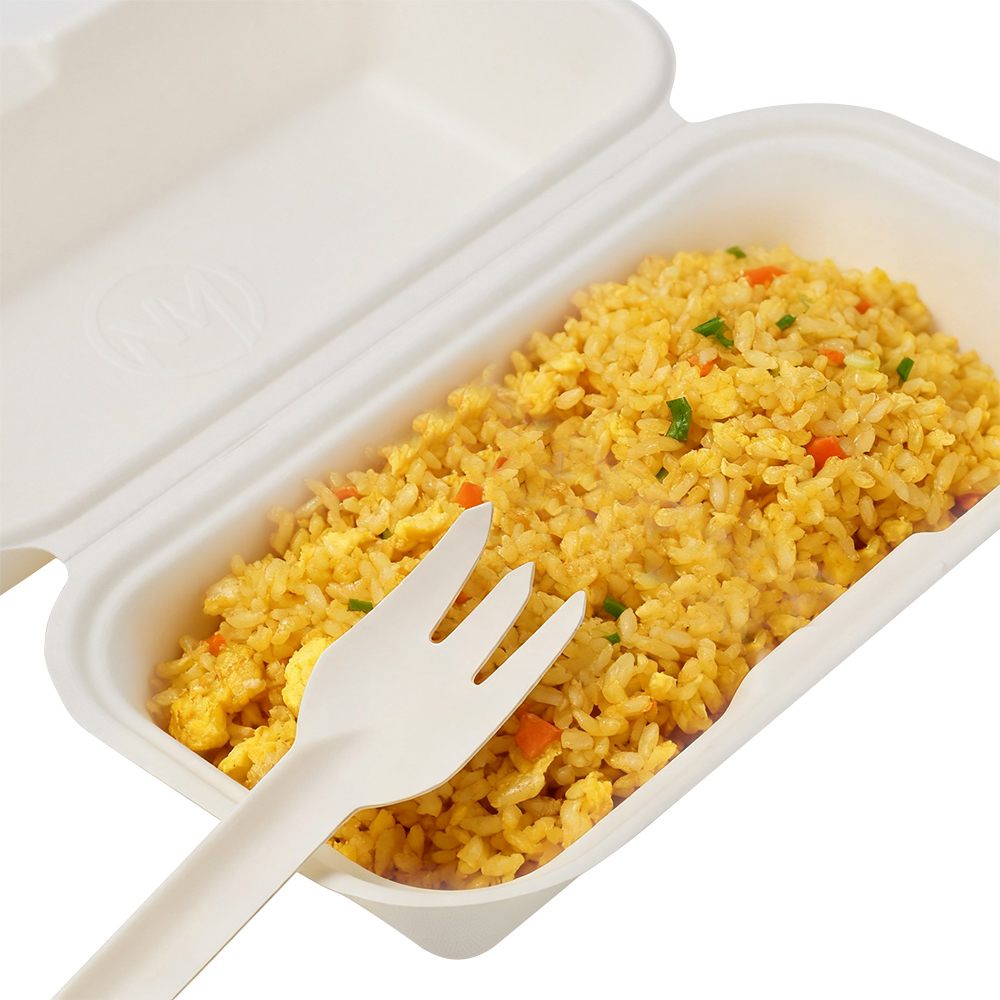
Engineering Strength into Sugarcane Bagasse Cutlery
Reinforced handles and strategic fiber alignment for load-bearing resilience
The durability of sugarcane bagasse cutlery begins with its natural fibrous structure: bagasse contains 40–50% cellulose, whose long, interlocking chains deliver inherent tensile strength of 10–20 MPa. During pulp molding, manufacturers align these fibers along the longitudinal axis—particularly in handles—to convert raw rigidity into functional bending resistance. This orientation allows spoons and forks to withstand typical service loads without permanent deformation. Independent testing confirms that well-engineered bagasse utensils support up to 2.5 lbs before flexural failure (Biodegradable Packaging Institute, 2023), matching the performance of polystyrene alternatives. Complementing fiber alignment, subtle handle tapering and ribbing further distribute stress across high-load zones. The result is cutlery that retains shape when scooping dense foods or cutting soft solids—avoiding the brittleness common in many bioplastics. By optimizing both fiber architecture and ergonomic geometry, sugarcane bagasse achieves the structural resilience needed for heavy-duty food service.
Compression molding precision: How density and wall thickness prevent snapping
Compression molding is the decisive step that transforms loose bagasse pulp into snap-resistant cutlery. Under controlled heat (120–180°C), pressure, and dwell time, pre-formed pulp is pressed into heated molds—collapsing voids and compacting fibers into a dense, uniform matrix. Final wall thickness typically falls between 2–3 mm, while density is tuned to 0.4–0.6 g/cm³. Higher density directly increases modulus of rupture, significantly reducing susceptibility to sudden fracture under lateral stress. Crucially, eliminating porosity ensures homogeneity: even minor inconsistencies can act as crack initiation points, so consistent cross-sectional integrity is non-negotiable. This precision yields a key functional advantage—under excessive force, the cutlery bends slightly rather than snapping, enhancing both safety and user confidence. Leading producers validate this behavior using standardized three-point bend tests on every production batch. Through mastery of compression molding, manufacturers deliver sugarcane bagasse cutlery that rivals conventional plastics in everyday toughness—while remaining fully compostable.
Real-World Durability: Moisture, Heat, and Mechanical Stress Performance
Sustainable disposable cutlery must perform reliably in actual food service—not just meet lab benchmarks. For sugarcane bagasse, real-world resilience depends on three interdependent factors: resistance to moisture intrusion, stability across thermal extremes, and endurance under mechanical stress from cutting, stirring, and stacking. These determine whether a spoon holds its shape in hot soup—or a fork survives piercing chilled, acidic salads.
Moisture resistance and thermal stability under hot/cold food service conditions
The dense, low-porosity matrix achieved through compression molding grants bagasse cutlery strong inherent moisture resistance. Its lignocellulosic composition naturally repels liquid penetration, preventing the rapid softening seen in uncoated paper products. In hot applications, it maintains structural integrity at typical serving temperatures—retaining rigidity even after prolonged contact with stews or beverages near 90°C. Cold conditions present a different challenge: condensation can compromise surface cohesion, yet the material’s minimal swelling and stable surface profile help it remain firm. This balanced performance ensures consistent functionality whether deployed in a humid outdoor catering event or a high-volume indoor buffet line—making it a dependable choice for operators prioritizing both sustainability and operational reliability.
Commercial Validation: Sugarcane Bagasse Cutlery in High-Demand Food Service
Before scaling procurement, food service operators require evidence that eco-friendly cutlery won’t fail during peak demand. Sugarcane bagasse cutlery proves its mettle in the most demanding real-world environment: the fast-paced, high-heat, high-handling setting of a food truck kitchen.
Food truck trial results: Breakage rates, user feedback, and comparison to PLA alternatives
A two-month field trial across five high-volume food trucks in Austin, Texas, directly compared sugarcane bagasse cutlery against standard PLA utensils under authentic service conditions—including use with tacos, stir-fries, and curries, followed by commercial three-sink washing with industrial detergents. Sugarcane bagasse recorded a breakage rate of just 3.2% per 1,000 uses, substantially lower than the 14.8% observed for PLA (Foodservice Packaging Institute, 2024). Customer feedback highlighted superior performance in hot, greasy applications: unlike PLA forks—which often soften and sag after 10 minutes in hot broth—bagasse utensils retained full rigidity and control.
| Metric | Sugarcane Bagasse Cutlery | PLA Cutlery |
|---|---|---|
| Breakage rate (per 1k uses) | 3.2% | 14.8% |
| Customer “sturdy” rating | 85% | 42% |
| Heat tolerance (no bending) | Up to 200°F | Up to 140°F |
Post-service surveys of 500 patrons confirmed these findings: 92% reported no bending or warping when using bagasse cutlery with hot, greasy dishes, and 85% rated it as sturdier than PLA. These outcomes reflect the synergistic benefits of compression-molded density and reinforced handle design—validating sugarcane bagasse cutlery as commercially ready for high-stakes, mobile food service operations.
FAQ
What is sugarcane bagasse cutlery made of?
Sugarcane bagasse cutlery is made of the fibrous by-product left after extracting juice from sugarcane. Its lignocellulosic composition gives it natural strength and durability.
How durable is sugarcane bagasse cutlery?
Sugarcane bagasse cutlery can support up to 2.5 pounds of load before flexural failure, ensuring excellent load-bearing capacity and resilience for food service.
Is sugarcane bagasse cutlery compostable?
Yes, sugarcane bagasse cutlery is 100% compostable, making it an environmentally friendly alternative to plastic utensils.
How does sugarcane bagasse cutlery perform under different temperatures?
It remains durable in hot conditions up to 200°F and resists moisture penetration, ensuring reliable performance during food service.
How does sugarcane bagasse compare to other materials like PLA cutlery?
Compared to PLA, sugarcane bagasse cutlery has a lower breakage rate, higher heat tolerance, and superior sturdiness, especially in hot and greasy applications.


